Energy transition
Reducing demands in hard-to-electrify sectors can reduce pushback risks

Some sectors are more difficult to electrify than others. Photo: Kateryna Babaieva via Canva.
Transitioning to renewable energy does, in itself, require energy. But how much? A new model finds that phasing out all fossil fuels in EU by 2035 would require up to 39% of the current total energy supply.
- Completely phasing out fossil fuels would require reallocating significant amounts of energy
- Reallocating this energy from one use to another, could lead to societal disruptions
- Efficiency and targeted sufficiency are key — particularly in energy-intensive and hard-to-electrify sectors
What if there were no financial or logistical barriers to the energy transition? How fast could we do it?
An international research team, including Centre researcher Louis Delannoy, developed a new model that calculates the electricity needed to replace fossil fuels in each major economic sector plus the required energy to build the infrastructure that makes this switch possible.
The energy transition is necessary, but it requires strategic choices about where and how energy is used for it to be fair, just, and inclusive.
Centre researcher Louis Delannoy
The study, published in the journal Renewable and Sustainable Energy Reviews, shows that that our path to net-zero needs a rethink. In the most ambitious scenario – phasing out all fossil fuels by 2035 – the annual energy requirements for the transition would peak at an amount equivalent to 39% of the EU’s current total energy supply. Even when averaged more evenly over time, this figure remains at a substantial 25%. Meanwhile, for a 2050 phase-out, the figures are 24% and 19%, respectively.
“We found that completely phasing out fossil fuels would require reallocating significant amounts of energy from current uses – transport, heating, non-energy manufacturing – to build transition infrastructure,” says lead author Ugo Legendre from Imperial College London.
He further notes that these energy requirements often are absent from mainstream discussions about the energy transition that concern the public, politics and even the economy.
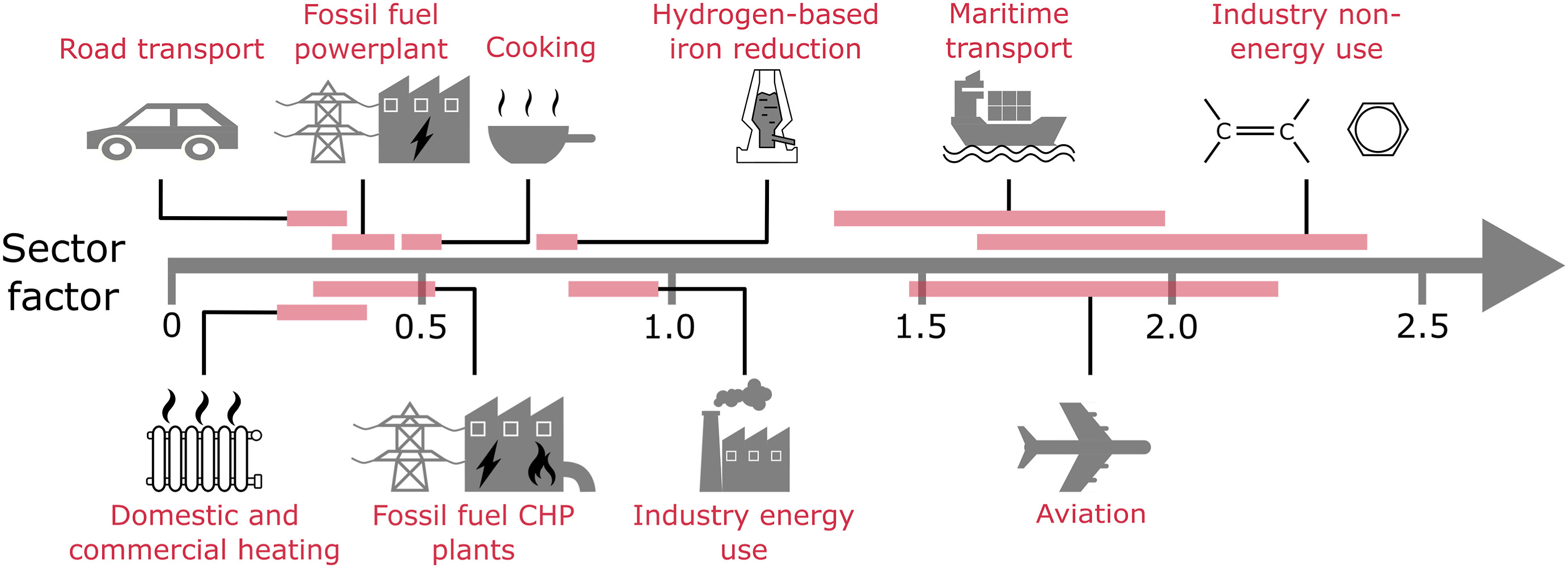
Summary of the sector factors calculated. Sectors on the left have lower sector factors, meaning less electricity is required to substitute a unit of fossil fuel in this sector, while sectors on the right have higher sector factors. The shaded bars represent the likely range (3 standard deviations) of the values given current estimates, and the maturity of the technology used. Marine transport, aviation and industry non-energy use (i.e., energy carriers that are used as raw materials in production processes, for example chemical feedstock for plastics, lubricants, or asphalt) are based on the least mature technologies and hence have the largest uncertainties and ranges.
Strategies to lower disruptions risks
Because this energy must come from the existing system, rapid transitions could create short-term societal disruptions if not carefully planned. However, the authors stress that these findings are not an argument for delay. Instead, they highlight the importance of prioritizing efficiency and targeted sufficiency — particularly in energy-intensive and hard-to-electrify sectors such as aviation, plastics and heavy industry.
“Reallocating this energy from one use to another, could lead to societal disruptions. Our model can provide a quantitative basis for assessing these disruption risks,” says Centre researcher Louis Delannoy, one of the co-authors. He adds that “the energy transition is necessary, but it requires strategic choices about where and how energy is used for it to be fair, just, and inclusive.”
The study also finds that relying heavily on hydrogen instead of direct electrification would significantly increase overall energy requirements. The authors argue that better accounting for the energy cost of the transition itself can help policymakers design faster and safer decarbonization pathways.
This news story is an adapted version from an article published by the Imperial College.
Legendre, U., Delannoy, L. & Brito-Parada, P. 2026. Physically consistent sectoral pathways for phasing out fossil fuels. Renewable and Sustainable Energy Reviews.
-

Green subsidies may have hidden costs, experts warn
An international group of economists and scientists say government subsidies risk locking in unsustainable practices.
-

24 reforms for a people-centred climate policy in Sweden
The research programme Fairtrans , hosted by the Centre, presents a groundbreaking agreement for a people-centred climate policy in Sweden, backed by major Swedish civil society organisations.